
How to Compare NDIS Providers With Confidence
 Prefer MySolas


Insight Description
Choosing the right NDIS provider is one of the most important decisions you will make. The provider you pick shapes your daily routine, your sense of safety at home, your progress toward your goals, and ultimately, your quality of life. But with thousands of providers operating across Australia, comparing them can feel overwhelming.
The good news: there’s a clear framework you can use to narrow the field, weigh trade-offs, and make a decision you feel good about. This guide walks you through the comparison points that actually matter, how to balance quality against convenience, and how MySolas can take a lot of the guesswork out of the process.
Why comparing providers matters more than ever
Under the NDIS, you have choice and control over who delivers your supports. That’s a powerful right, but it also puts the responsibility of the research burden on yourself and your family. A mismatched provider can mean missed goals, wasted funding, stress, and in some cases, safety concerns. A well-matched provider, on the other hand, can transform someone’s independence, confidence, and community connection.
The stakes are real, which is why taking a structured approach to comparison is so worthwhile. Before you start comparing, it’s worth mapping out exactly what your plan covers. The MySolas Plan Navigator is a good starting point for understanding how your funding translates into the support you can access.
The most important comparison points
Not every factor is equally important, and the right priorities will shift depending on whether you’re looking for a support worker, a Supported Independent Living (SIL) home, therapy services, or plan management. That said, the following nine comparison points apply to almost every NDIS decision.
1. Registration status
NDIS providers fall into two main groups: registered and unregistered. Registered providers have been formally approved by the NDIS Quality and Safeguards Commission, undergone independent audits, and are required to comply with NDIS Practice Standards. Unregistered providers operate under the same NDIS Code of Conduct but aren’t subject to the same regulatory oversight.
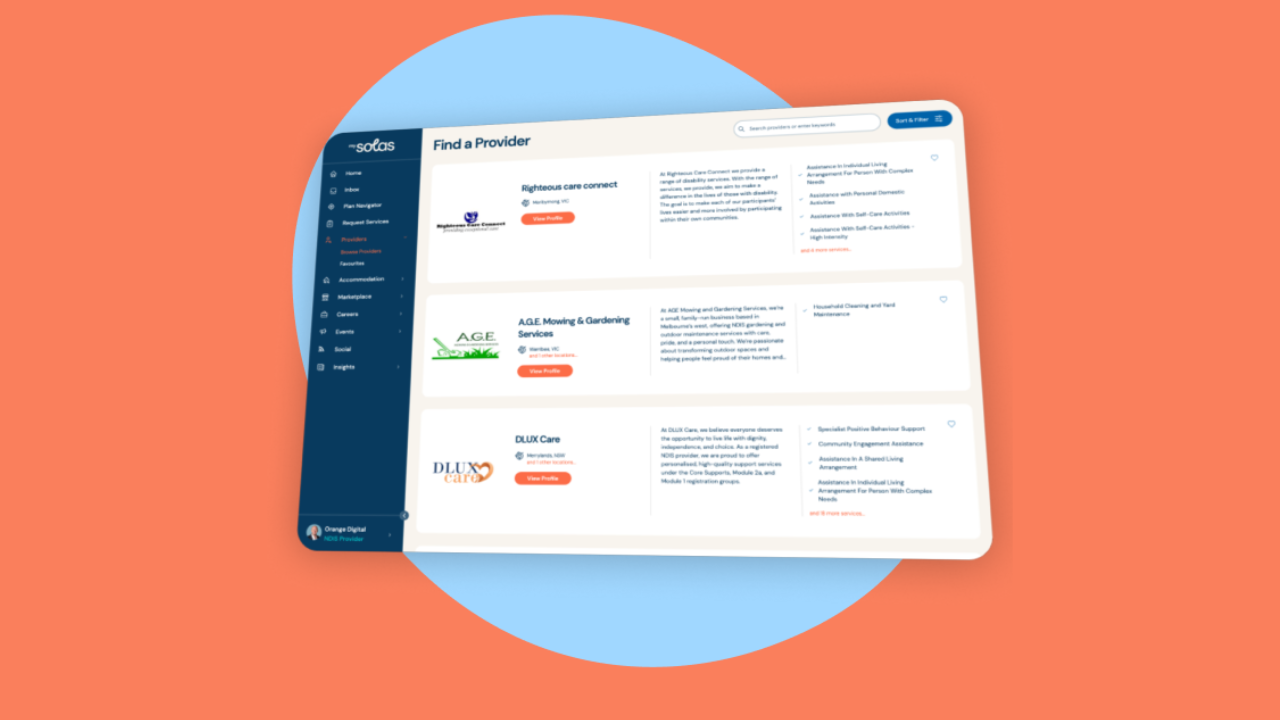
Your plan management type determines who you can use. Agency-managed participants can only use registered providers. Plan-managed and self-managed participants can choose either, though certain high-risk supports (Specialist Disability Accommodation, behaviour support, and from 1 July 2026, all Supported Independent Living) must be delivered by registered providers. On the MySolas provider directory, you can filter specifically for NDIS Registered Providers to match your plan management type.
2. Services offered and specialisations
A provider that ticks every box on paper might still be wrong for your situation. Look at the specific service categories they deliver. Someone who needs complex community nursing care needs very different expertise from someone seeking social and community participation support. Check whether the provider has genuine experience with your disability type,) rather than simply listing it on their website.
3. Location and service area
Does the provider operate where you live? Many providers cover a primary suburb plus surrounding areas, but coverage thins quickly in regional and remote locations. Some offer telehealth or mobile services, which can dramatically expand your options if in-person availability is limited in your area. If accommodation is part of what you’re searching for, the MySolas accommodation listings let you explore SIL, SDA, and other housing options alongside provider searches.
4. Availability and wait times
A fantastic provider with a six-month waitlist isn’t helpful if your plan starts next week. Availability categories typically fall into immediate, up to two weeks, two to four weeks, or four to eight weeks. Be honest about how much waiting you can reasonably, manage.
5. Staff quality, qualifications, and matching
The actual humans delivering your support matter more than the logo on the invoice. Ask about worker screening checks, qualifications, training requirements, and how the provider matches support workers to participants. Continuity of staff is a big quality-of-life factor; some providers rotate workers frequently, while others prioritise long-term matches. If you’re specifically looking for individual support workers rather than organisations, you can filter for that in the MySolas provider search.
6. Communication style and responsiveness
How quickly do they respond to enquiries? Do they answer your questions clearly, or rely on vague, scripted marketing language? Are they willing to meet with you before any commitment? Poor communication during the sales process almost always predicts poor communication once you’re a client. At MySolas, we have the MySolas Match where we find you the perfect matches for you to choose them, making it easier for you to find the best provider that matches your specific needs.
7. Cultural fit and language
For many participants, being supported by someone who shares their cultural background or speaks their language isn’t a bonus; it’s essential. Good providers offer workers who speak a range of languages including Aslan, Arabic, Cantonese, Mandarin, Hindi, Punjabi, Vietnamese, and understand cultural nuances that shape how support should be delivered.
8. Reviews, reputation, and references
Word of mouth from other participants and families is often one of the most trusted and influential sources of information. Look at reviews, ask your support coordinator for honest feedback, and don’t be afraid to request references. The MySolas Insights is also a useful place to learn from the real experience of other participants and families navigating the NDIS, and the MySolas Events page offer opportunities to connect in person and hear firsthand experiences.
9. Pricing and plan management compatibility
Registered providers must follow the NDIS Price Guide. Unregistered providers working with self-managed participants can set their own rates, which may offer better value or come at a premium. Make sure the provider can invoice in a way that aligns with your plan management arrangement.
How to weigh quality vs convenience
This is where most participants get stuck. The closest provider isn’t always the best one. The best-credentialed provider isn’t always available. The friendliest voice on the phone might not deliver the specialised clinical support you need.
Here’s a practical way to think about the trade-off.
Start with the non-negotiables. These are the things you cannot compromise on, usually related to safety, clinical need, or access. Examples: a registered provider if your plan is agency-managed; nursing qualifications if you have complex health needs; wheelchair-accessible premises; a worker who speaks your first language.
Identify your high-value preferences. These significantly improve your experience but aren’t deal-breakers. Examples: a provider within 20 minutes of home, a consistent support worker rather than a rotating roster, weekend availability, experience with your specific condition.
Accept that nice-to-haves are negotiable. These are the things you’d love but can live without. A sensory garden, an on-site pool, or a games room are great bonuses, but they shouldn’t drive the decision if the core support isn't there.
Quality generally matters most for higher stakes supports anything involving medical complexity, behaviour support, accommodation, or long-term therapeutic relationships.
For lower-stakes, everyday supports like transport or domestic assistance, convenience can play a bigger role, where reliability and proximity often deliver the most practical value.
Making a more informed decision
Once you’ve narrowed your list to three or four candidates, the final step is genuine comparison rather than gut instinct. A few tactics can help with this.
Start by booking a conversation with each shortlisted provider. A 20-minute call tells you more than an hour of reading through their website. Pay attention to the questions they ask you; good providers will focus on understanding your goals before they talk about their services.
Ask the same set of questions to each provider so you can compare like for like.
Useful questions include:
- How do you handle it when a support worker and participant aren’t a good match.
- What’s your process if I want to make a complaint.
- How often will we review my supports.
- What happens if my needs change mid-plan.
Trust red flags when you see them. Be cautious of pressure tactics, vague answers about qualifications, reluctance to put things in writing, or dismissiveness toward your questions. These are all signals that it may be best to walk away.
Keep notes. After each conversation, jot down impressions while they’re fresh. When you’re comparing several providers later, those notes Become incredibly valuable.
Beyond providers themselves, don’t overlook the supporting tools and supplies that make NDIS living easier - the MySolas Marketplace is worth a browse for assistive products and services that might complement your chosen provider.
Skip the legwork. Get matched to the right provider with MySolas Match
If filtering, shortlisting, calling, and comparing sounds like a lot, there’s a simpler path. MySolas Match is the platform’s guided matching service, built specifically for participants, families, and support coordinators who want the right provider without the long search process.
Here’s how it works:
- Tell MySolas about you. Share your support needs and preferences in a short online form — it takes about 3 to 5 minutes.
- The MySolas team finds your matches. Real humans (not just an algorithm) review your request and identify providers that genuinely fit your goals, location, plan type, and personal preferences.
- You connect and choose. You’re introduced to your matches and decide who feels right.
The difference with MySolas Match is that it flips the comparison process. Instead of wading through hundreds of listings hoping to find the right fit, you describe what you need and get a shortlist back that’s already been filtered for relevance. For participants juggling plan reviews, appointments, and day-to-day life, that saved time is genuinely valuable.
It’s especially useful when your needs are complex, when you’re new to the NDIS, or when you’ve had a bad provider experience and want extra confidence before committing again.
→ Start your MySolas Match now ←
Choosing with confidence
Comparing NDIS providers with confidence comes down to three things: knowing what matters, knowing what you can and can’t compromise on, and having the right tools to cut through the noise. The points above give you the framework. Your own priorities determine the weighting.
Whether you use the provider directory to search yourself or MySolas Match to get paired by our team, it gives you the ability to apply it all without burning through hours of research.
The right provider is out there. Taking the time to compare properly is how you find them and how you make sure your NDIS plan delivers the life you want to live.
Insight Info
.png)
Written by
MySolas