
NDIS Providers: Your Guide to the October 2026 SCHADS Pay Changes
 Prefer MySolas


Insight Description
From 1 October 2026
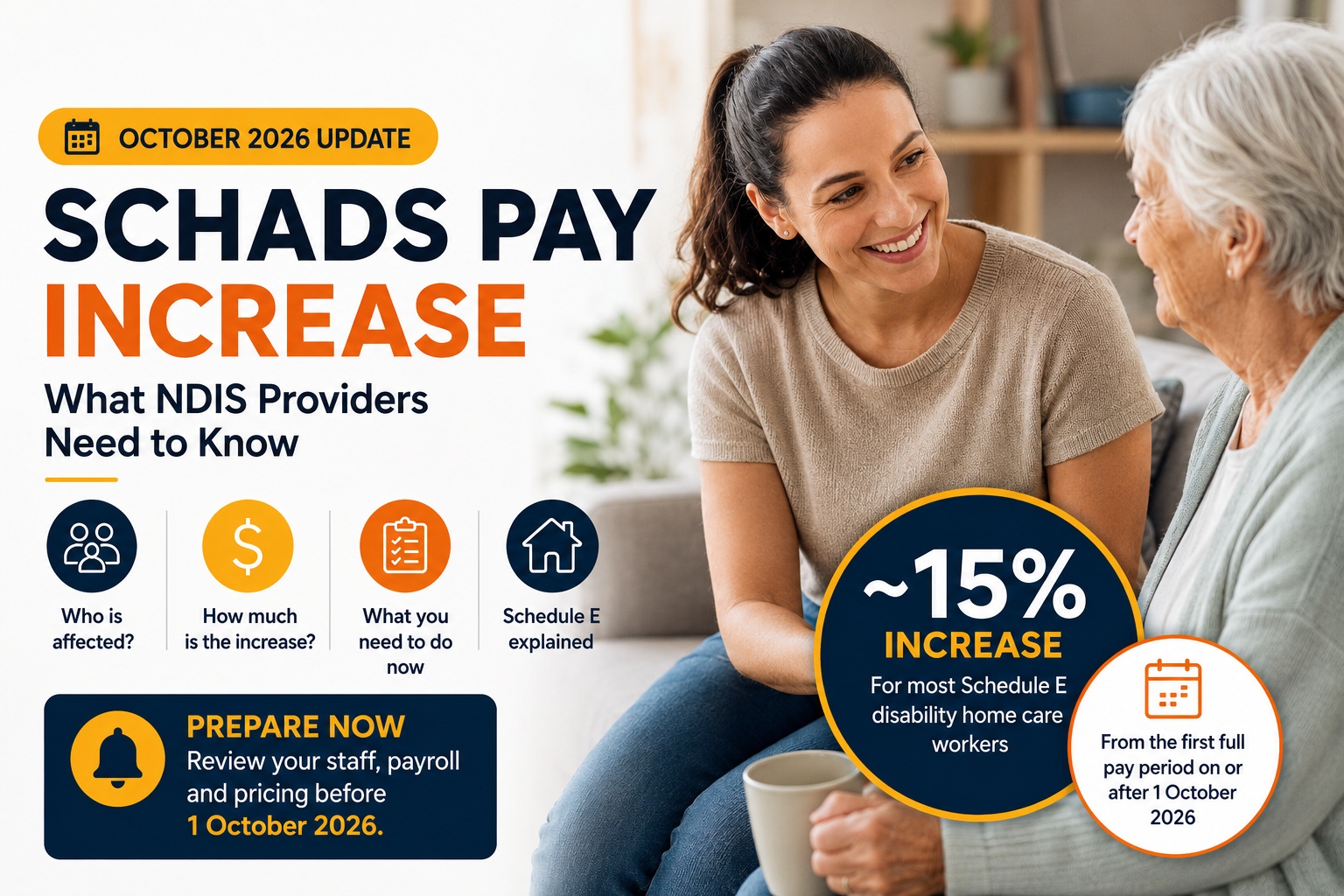
From 1 October 2026, some disability support workers covered under Schedule E of the SCHADS Award will receive a pay increase of around 15%.
If you provide one-to-one disability support in a participant’s private home, this change may affect your payroll and staffing costs. Providers should review their staff classifications and pay rates before October.
Why are the rates increasing?
In June 2026, the Fair Work Commission reviewed pay rates for work that has traditionally been performed mainly by women. The Commission found that disability home care workers under Schedule E were being paid less than workers doing similar home care work in aged care.
Aged care home care workers received a similar pay adjustment in 2023. The Commission found there was no reasonable basis for disability home care work to be valued lower when the work being performed is similar.
This has resulted in the proposed increase from October 2026.
How much is the increase?
For most workers covered by Schedule E, the increase will be approximately 15%.
The new rate will apply from the first full pay period starting on or after 1 October 2026.
There are two classifications where the increase may be slightly less than 15%:
- Level 4, Pay Point 2
- Level 5, Pay Point 2
If you have employees at these levels, do not automatically add 15%. Check the official Fair Work pay rate for their classification.
Who does the increase apply to?
The increase only applies to employees correctly classified under Schedule E – Home Care Employees – Disability Care.
Understanding the different SCHADS schedules is important.
Schedule B
Usually covers social and community services work such as:
- Shared disability accommodation
- Group homes
- Day programs
- Community access
- Case management
- Shared rostered support for several participants
The October Schedule E increase does not automatically apply to Schedule B workers.
Schedule C
Covers areas such as:
- Crisis accommodation
- Homelessness services
- Refuges
- Transitional housing
This increase does not apply to Schedule C.
Schedule D
Covers family day care coordination employees.
This increase does not apply to Schedule D.
Schedule E
This is the main schedule affected by the October increase.
It generally covers disability home care support delivered:
- In the participant’s own private home
- Directly to the participant
- Usually on a one-to-one basis
This can include:
- Personal care
- Domestic assistance
- Home care
- Home maintenance
- Other individual disability supports
Schedule F
Schedule F covers home care employees providing services to aged care clients.
These workers had their own pay adjustment previously, so the October 2026 Schedule E increase is not intended for them.
Be careful with SIL classifications
One of the biggest areas of confusion is Supported Independent Living (SIL).
SIL is an NDIS funding type. It does not automatically tell you which SCHADS Award schedule applies. You need to look at how the support is actually being delivered.
For example:
Shared SIL
If several participants live together and support workers provide shared, rostered support across the household, the workers may fall under Schedule B.
Individual SIL
If one participant lives in their own private home and receives individual one-to-one support, the worker may fall under Schedule E. This means two workers can have the same job title but be covered by different SCHADS schedules depending on the work they actually perform.
Do not classify employees simply because the participant’s NDIS plan says “SIL”.
Look at:
- Where the participant lives
- How many participants live in the home
- Whether the support is one-to-one
- Whether workers support several residents during the same shift
- The actual duties the employee performs
What providers should do before October
Before 1 October 2026, providers should:
- Review staff classifications.
Check which employees are currently classified under Schedule E. - Check each employee’s level and pay point.
Make sure employees are classified correctly based on their actual duties. - Confirm the new pay rates.
Use the official Fair Work Ombudsman SCHADS Award pay information before updating payroll. - Update payroll systems.
Make sure the new rates apply from the correct full pay period. - Review your business costs.
A 15% wage increase can have a significant impact on staffing expenses. - Review your NDIS pricing and margins.
Check whether the income you receive for the supports you provide will cover the increased wage costs. - Review SIL arrangements carefully.
Do not assume all SIL workers fall under the same SCHADS classification.
Why this matters
Getting the SCHADS classification wrong can create more than an October payroll problem.
If an employee has been classified under the wrong schedule or pay level, there may already be an underpayment issue.
Providers should use this change as an opportunity to review:
classification → pay rate → payroll → service pricing → business sustainability
Important
Award rates and Fair Work decisions can change.
Before changing payroll, always confirm the final rates directly through the Fair Work Commission and Fair Work Ombudsman SCHADS Award Pay Guide (MA000100).
If you are unsure whether a worker should be classified under Schedule B or Schedule E, seek professional HR, industrial relations or employment law advice rather than relying only on the name of the employee’s position or the participant’s NDIS funding type.
If you need support with your workforce planning, get in touch with me today at cherryl@mysolas.com.au
Insight Info
.png)
Written by
MySolas